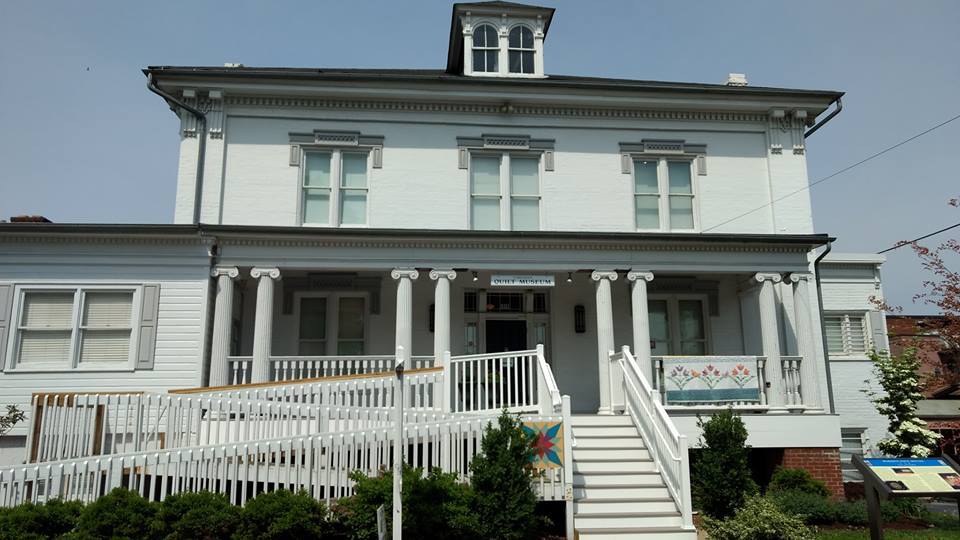
Warren-Sipe House
The Warren-Sipe House in downtown Harrisonburg is a historic Greek Revival-style building constructed in 1856 with Italianate details and was purchased by the City of Harrisonburg in 1956. Most recently known as the home of the Virginia Quilt Museum, the house has served many purposes over its long history, including as a circuit court. It is not open to the public.
Key facts about the Warren-Sipe House:
- Original owners: The house was built by prominent attorney Edward T. H. Warren, a descendant of Harrisonburg’s founder (and his Uncle William Rice) for about $6,000. He deeded the house to his mother and grandmother. As a lieutenant in the Valley Guards, a Rockingham County militia company, Warren attended the trial and execution of John Brown in Charles Town (in present-day West Virginia) in 1859.He served in the confederacy and died at the Battle of the Wilderness in 1864.
- Civil War: During the Civil War, the house was used to care for Confederate soldiers. Notable patients included 19-year-old Joseph “Boy Major” Latimer, the youngest artillery battalion commander in the Confederate Army, who died in the house on August 1, 1863. His arm was amputated as a result of injury at Gettysburg after it was infected with gangrene he died in the house. He had been attending VMI before he joined the war.
- Paying a Debt: In 1873, Harriet Warren sold the house to Benjamin and Sarah Long who sold the house before fully paying the debt. John Samuel Harnsberger bought the house and paid off the final debt. He was a lawyer who served one term as mayor and had a failed attempt to be elected Senator. He rented the house to Mrs. Hoxsey and then to John Yancey. He finally sold the house for $4,150 in 1894 to George E. Sipe, a lawyer and state delegate who made several improvements and alterations to the building. Sipe had previously shared a law practice with Harnsberger. George’s daughter Enid was married in the home.
- Unusual Connection: George Sipe’s father owned a barn in the county which was burned down in 1878 by 17-year-old James Ergenbright. James was arrested and plead guilty saying his actions were induced by Charlotte Harris – she was brought to magistrates for a hearing at the Sipe farm and then was taken to the jail 15 miles away in Harrisonburg. She was abducted and lynched.
- Enslaved People: The household included several enslaved people. In 1856, there are records indicating eight people were enslaved in the house, four by Edward Warren (a male age 47, a female age 37, a female age 18 and a male age 12 or 13) and four enslaved by his mother Harriet Warren (a male age 36, a female age 30, a female age 7 and a female age 6).
- Changing Ownership: When George died in 1939 his wife Marien inherited the property until she died in February 1950. George’s will gave the property to his daughters to own it independently of their husbands. They rented the house to Daisy Monger who used it as a boarding house.
- Later public use: After being sold to the city for $47,500 in 1956, the building’s 22 rooms were remodeled for about $18,000 to serve as a Youth Center. Over the years the building housed city parks and recreation offices, business offices, Rescue and Communication Center, Inspection Unit and the Fire Department’s Admin Office. Around 1986 the Harrisonburg-Rockingham Historical Society used the home until 1993.
- Temporary Court: When the County Courthouse was being renovated in 1993 the house was used as the Rockingham Circuit Court and a jail cell was installed.
- Virginia Quilt Museum: From 1995 until June 2024, the house was home to the Virginia Quilt Museum. The Virginia Quilt Museum eventually moved out of the historic house to a new location in Dayton.
- Ghost stories: Due to its history as a hospital during the Civil war, some visitors reported seeing the ghost of a Confederate soldier Major Latimer, in the upstairs hallway.
(This information was gathered from numerous sources including the Virginia Quilt Museum which occupied the house from 1995 – 2024.)